The 2020 Tug Hill Recreation Guide is Available

Trail Map guide cover

The best way to experience the 2,100-square mile Tug Hill region is to think of yourself as an explorer wandering through the many trails and along the riverbanks inside one of the “last untouched wildernesses” in New York State.

The landscape is a unique mixture of thick forests, valley farmlands, deep gorges, large flowing rivers and scenic waterfalls, all setting the stage for a one-of-a-kind outdoor experience. A distinct advantage of this region is its smaller population—and means fewer than crowds, less time stuck in traffic, and no waiting in long lines.

Year-round outdoor fun

During the warmer weather, hiking kayaking, canoeing, fishing, camping, birdwatching, bicycling and mountain biking are population activities. The fall months offer stunning views of colorful foliage, a scenic experience that is a favorite amongst the most dedicated “leaf-peepers.”

In the winter, Tug HIll’s record-breaking snowfalls turn the region into a snowy wonderland filled with endless recreational possibilities. These heavy snowfalls attract plenty of winter sports enthusiasts looking for prime cross-country and downhill skiing, snowshoeing and snowmobiling, and even sled dog racing.

Water adventure

Pristine water is one of the most abundant resources in Tug Hill, which has a large network of 117,000 acres of wetlands, nearly 4,000 miles of streams and rivers, and four reservoirs.

Land adventure

Tug Hill has plenty of public parks, and rails varying in the distance and terrain, offering visitors and residents an opportunity to venture into the wilderness. Miles of accessible trails allow visitors to experience Tug Hill’s scenic forestlands and abundant wildlife.

The region is home to many animals, including deer, bobcat, bald eagles, foxes, and otters, along with countless numbers of birds. For years, Tug Hill has drawn avid bird watchers to the area.

The vast forestlands include both northern hardwoods and softwoods, which have been a bountiful source for wood products and paper manufacturing for decades.

Community discovery

The rich cultural heritage and history of Tug Hill can be discovered by traveling through its many rural communities, particularly at the time when a annual festival or event is being held. Many people living in Tug Hill make their living off of the land—farming and logging—which has earned the region a reputation as “a special place of working lands.”
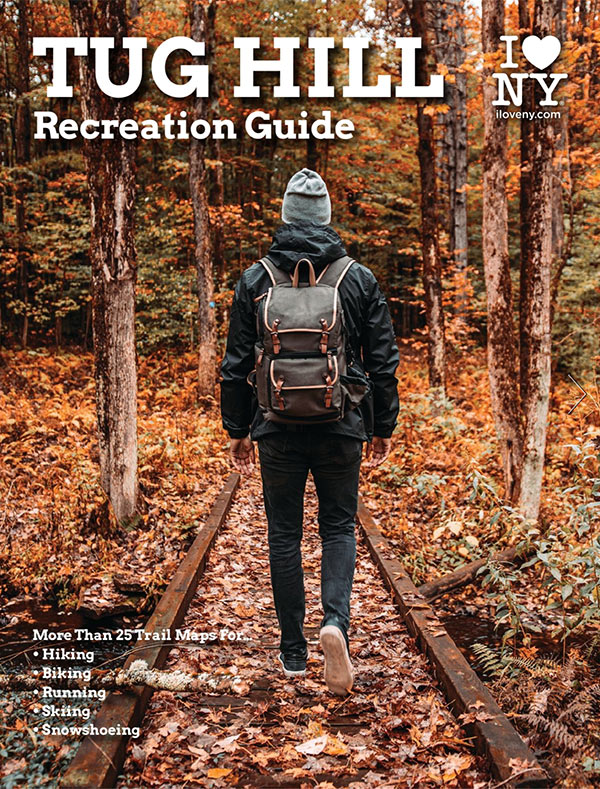
 

trail map guide for walks, hikes, running, snowshoeing, biking, paddles and more


Hit the Trails

For more than 25 Trail Maps and visitor information read the Tug Hill Recreation Guide >>

Learn more about Places to Explore
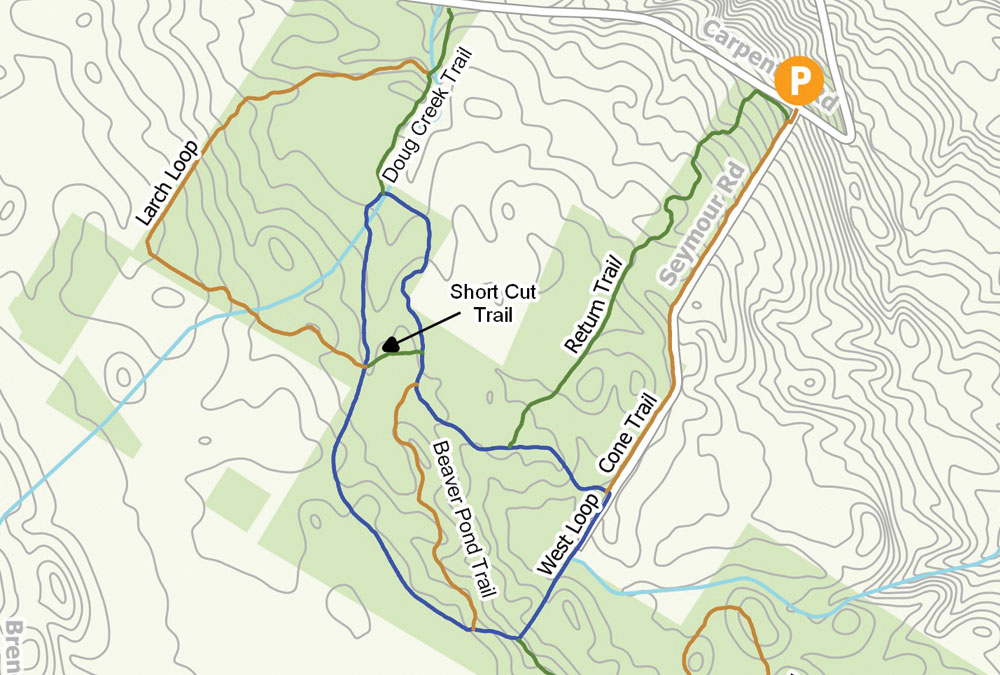
Get ready to explore Tug Hill

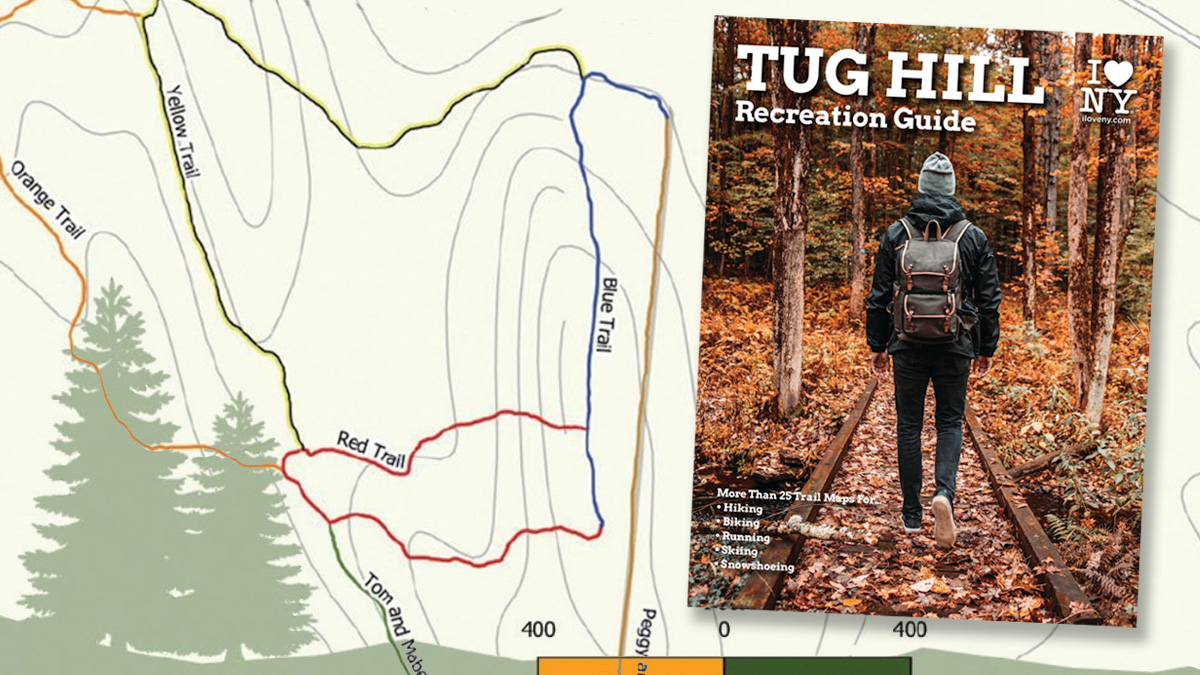
Map from trail guide

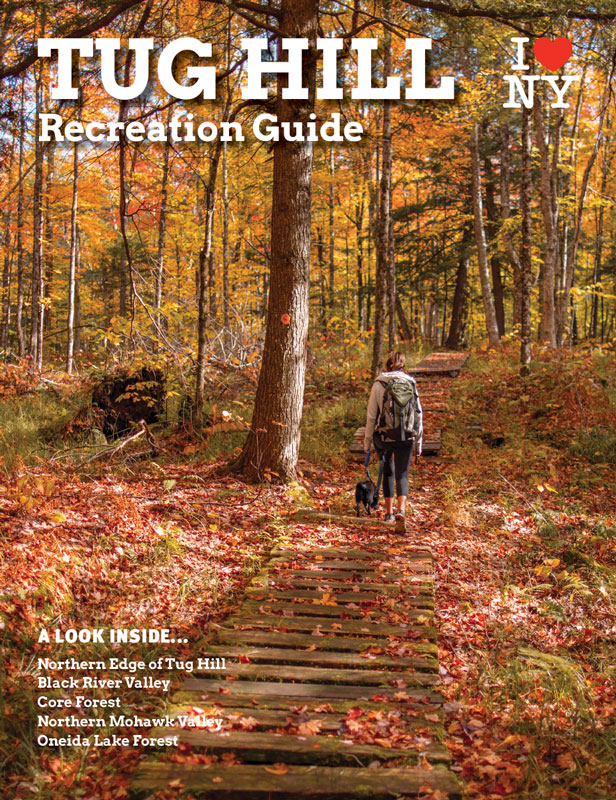
Tug Hill Recreation Guide coverGood news! The ever-popular Tug Hill Recreation Guide is newly updated and available cost-free at the Tug Hill Tomorrow Land Trust Office, the Tug Hill Commission, and our four County Tourism Promotion Agencies. In it you’ll find over 25 detailed trail maps, stunning photographs, regional overviews, and profiles of local communities.
This guide was created to promote visitation and non-motorized recreation throughout the Tug Hill region and trail maps from the guide will be available for download from our website soon.


Sign up for our eNews for updates on recreational Tug Hill outings

Have you ever wondered what the future of wildlife and water will be in Tug Hill?

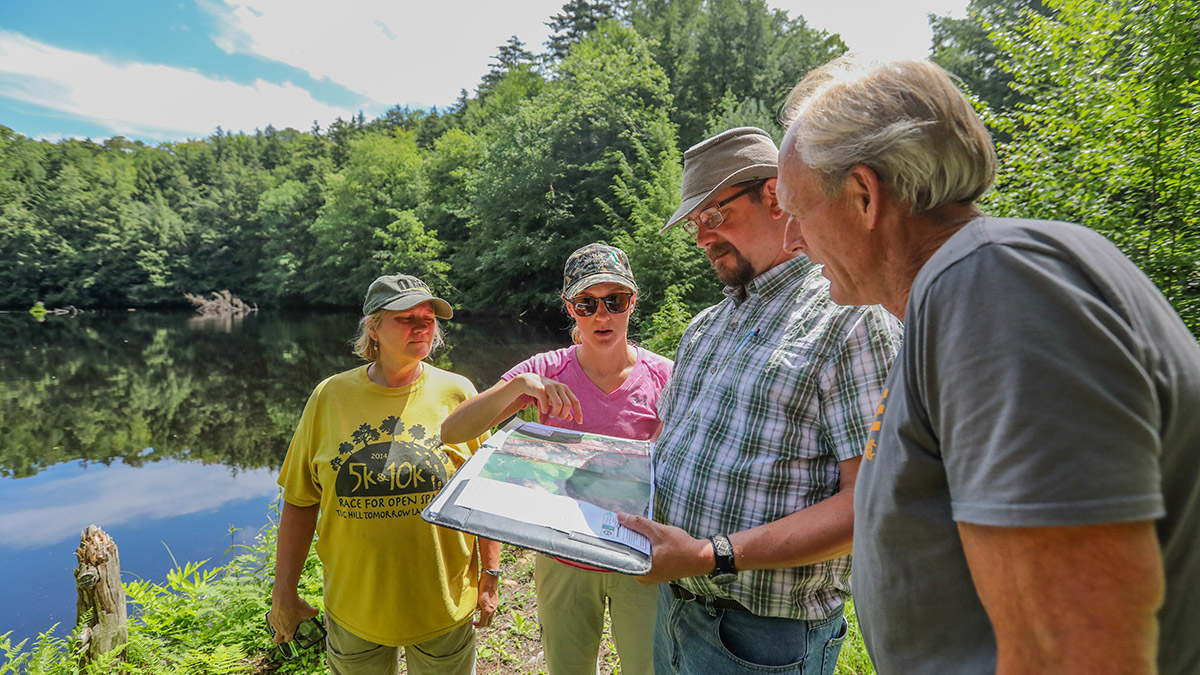
Ton Ka Wa Landowner Visit with The Nature Conservancy

Studies around the world, including the University of Florida, Wisconsin at Madison, Cornell University, and as far away as the University of Tasmania, are documenting that plants and animals are undergoing a mass redistribution due to climate change.

Indeed, a recent study from the Cornell Lab of Ornithology and the American Bird Conservancy noted we have lost 1/3 of our North American birds in less than 50 years, largely due to habitat loss and pesticides.

This adds to a growing body of research in the Northeast: isolated islands of habitat will not allow for the necessary movement and survival of wildlife. Instead, connecting corridors of woodlands and farmlands, waterways and wetlands, are a critical strategy for wildlife to flourish.

Good news for wildlife and communities

Local families and landowners will now have another opportunity to help. A recent grant to The Nature Conservancy
(TNC) from the New York State Department of Environmental Conservation’s Water Quality Improvement Program, in partnership with Tug Hill Tomorrow Land Trust, will allow for purchase of conservation easements (voluntary retirement of development rights) on lands that will protect ground and surface drinking water sources and benefit wildlife habitat.

The project spans several communities, with one focus area including West Canada Creek and Hinckley Reservoir.

Lands qualifying for these grants would contain woodlands and river frontage with the goal of conserving several thousand acres of privately-owned lands in the Black River Valley between Tug Hill and the Adirondacks. Limited development, hunting camps, recreation, and forestry would continue to be permitted.

With increasing severe weather events, forests also serve a vital role in filtering and absorbing water, reducing the impacts of flooding and gradually releasing water over time into neighboring rivers and ground water. Given that several Tug Hill Communities rely on reservoirs, aquifers and town wells, this benefits their drinking water supply and buffers them from periods of drought as well as the impacts of flooding.

Alissa Fadden of TNC explains that “This is a terrific project that benefits wildlife and our communities. We have a chance to ensure that the farms, wildlife and water resources remain a central part of this region’s identity and economic base.”

Explore more…

If you are interested in finding out more email Linda Garrett at [email protected].


“We have a chance to ensure that the farms, wildlife, and water resources remain a central part of this region’s identity and economic base.”

Alissa Fadden, Adirondack Chapter of the Nature Conservancy

Kids need to be the future of conservation

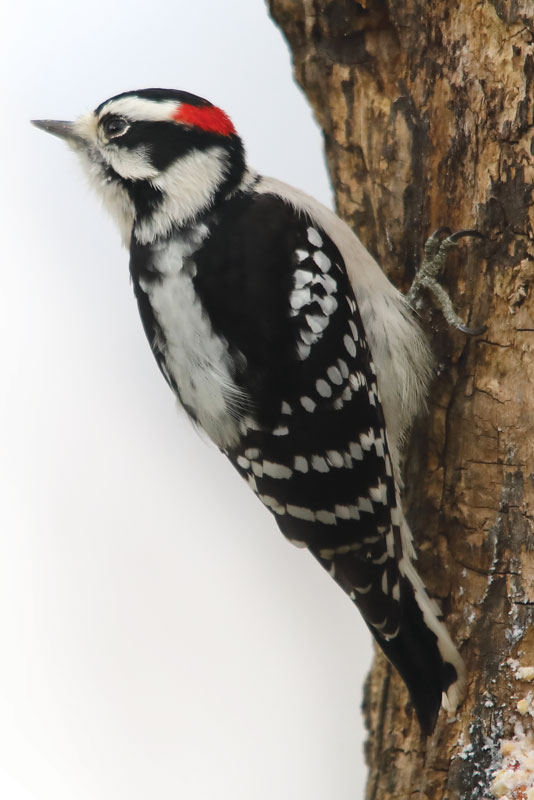
birdwatch

Have you heard similar comments from kids you know? You aren’t alone. The lure of technology and the couch are strong, but more and more, the youth of Tug Hill have programs to entice them outdoors.

woodpeckerIt turns out that kids—even rural kids—aren’t spending enough time in nature, or on farms, to feel comfortable and excited about the natural landscape.
Children ages five to 16 spend an average of six and a half hours a day in front of a screen (compared to around three hours, in 1995), according to research firm, Childwise.

Other research from a national report, The Nature of Americans, notes it’s more important than ever to support local families and kids by creating kid-friendly and accessible places for everyone to enjoy—ideally within 15 minutes of home.

Experiencing nature and green spaces through community parks, local conservation areas, a farm, or educational programming has been shown to improve a child’s ability to focus, reduce the level of attention deficit hyperactivity disorder (ADHD), and counter rising anxiety. These benefits are seen not only in youth, but also in adults.

This builds upon still more documentation that with regular, fun, and interactive experiences immersed in nature and farms throughout childhood, kids are more likely to feel comfortable with the sounds and smells of these landscapes.

Not only does that mean they are more likely to thrive, but it also means they are more likely to care about conservation as adults.

That’s why we are ramping up our programs with local libraries, schools, and youth programs.

Fun and interactive nature education, games, and access to birding programs can instill a love of learning, foster a greater ability for empathy, and reduce bullying. Plus, it helps raise kids who will feel more confident facing life-long challenges.

As Sarah Milligan Toffler from the Children and Nature Network observed, “With today’s kids being less connected to nature than previous generations, children and the natural world need each other now more than ever.”

Volunteers give more than time

Black River waterworks park

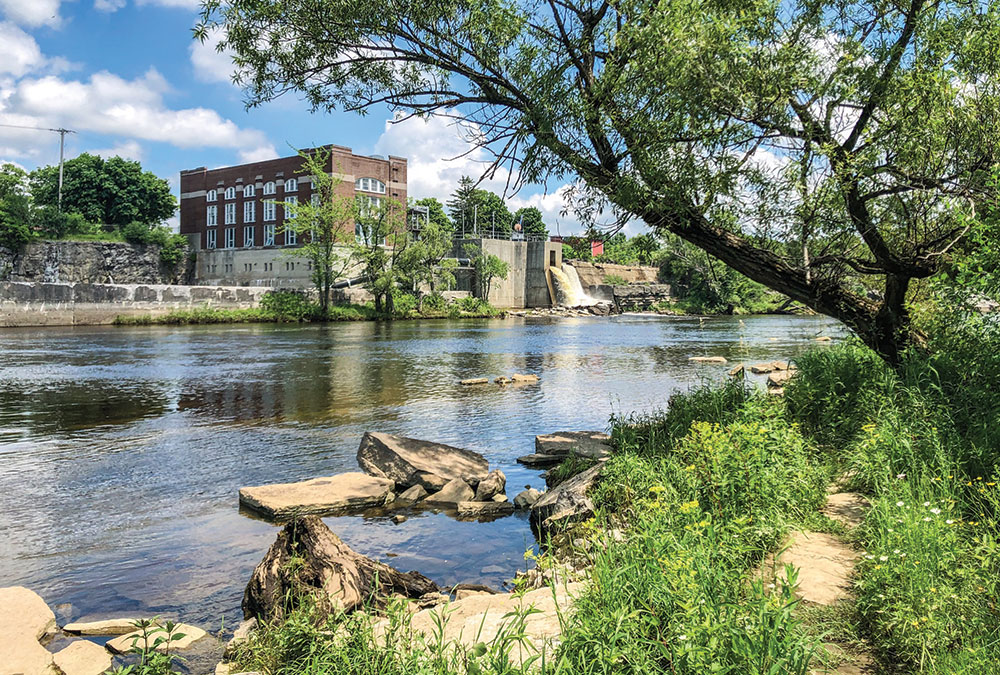
Imagine paddling down the Black River, a river that provides drinking water to the City of Watertown and Fort Drum, and discovering fishing line ensnared along the bushes—the very place where Great Blue Herons come to fish and river otter live.

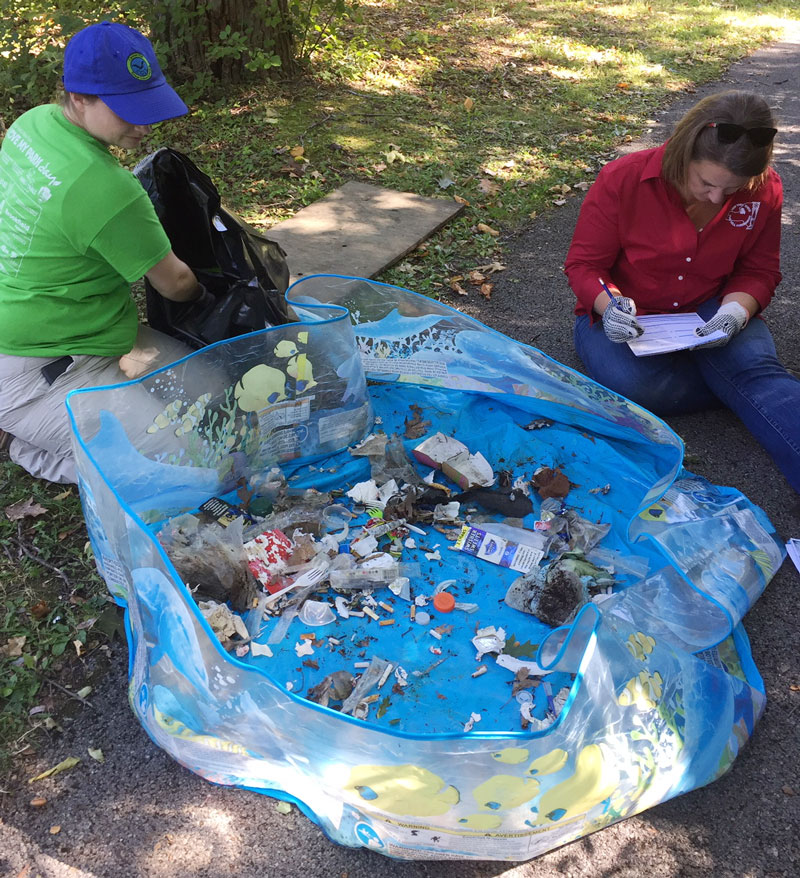
Emily and Jen with trash collected in a poolNow imagine fishing on the River and finding plastic bags, a kiddie swimming pool, and bottles polluting the shores, making it hazardous for people and wildlife alike.

Well, that’s now a distant memory for six miles of the Black River from Forestport to Dexter, where 431 pounds of plastic, construction material, cigarette butts, and household debris were extracted from its shores as part of a community cleanup hosted in partnership with the Lewis County Soil and Water Conservation District, the Tug Hill Commission, and the Tug Hill Tomorrow Land Trust.

The cleanup was part of a national effort to increase the health of local waterways and, ultimately, the ocean habitats into which they run.

The river cleanup was one of many volunteer projects throughout the year. Folks also pitched in to help develop and maintain the Tug Hill Traverse Trail and the trails at the Land Trust’s Joseph Blake Wildlife Sanctuary, led community programs, answered questions at events, and hosted local gatherings to celebrate conservation.

“I love to volunteer, out on the land, whether it’s helping with trails or taking photographs for the Land Trust, because together we are making a difference,” explained Zach Wakeman. We agree.

It’s people like Zach who share their passion for Tug Hill by volunteering their time and talents who make Tug Hill
a better place to live, work, and play.

We’d love to hear from you…

If you’d like to volunteer and join a growing team of people who have fun while making a difference, please call Lin Gibbs at 315-779-2239 or email her at [email protected]. We’d love to see you.

Dairy farmers conserving their land, family heritage

Huntley Family Farm

Dan Huntley’s family has worked the same land for 200 years. The iconic 720-acre farm, located in the town of Pierrepont, in St. Lawrence County, meets the foothills of the Adirondacks with sweeping views of the St. Lawrence Valley.

Now a certified organic dairy farm, the Huntley Farm is within the watershed and larger habitat area of the St. Lawrence River, only 30 miles away. As part of the farm’s income diversification, the Huntley’s run a bed and breakfast, sell firewood, and manage their woodland as a sugarbush and for sustained timber production.

Dillon, Dan’s son, is investing in soil improvements to increase soil health and productivity. He also grows local organic grain for his dairy and to sell to other farmers, and is working towards increasing his maple sugaring operation to over 5,000 taps.

The farm has now joined the ranks of a growing number of farmers who would prefer to conserve their land rather than face the prospect of it being sold for development.

“Many of the dairy farms in our region have gone out of business because the cost of running a dairy farm is outpacing the price of milk,” explains Dillon. “We needed a way to conserve the farm and lower our operating costs. Conserving it, and diversifying the operation, makes it easier for me to take over the farm.”

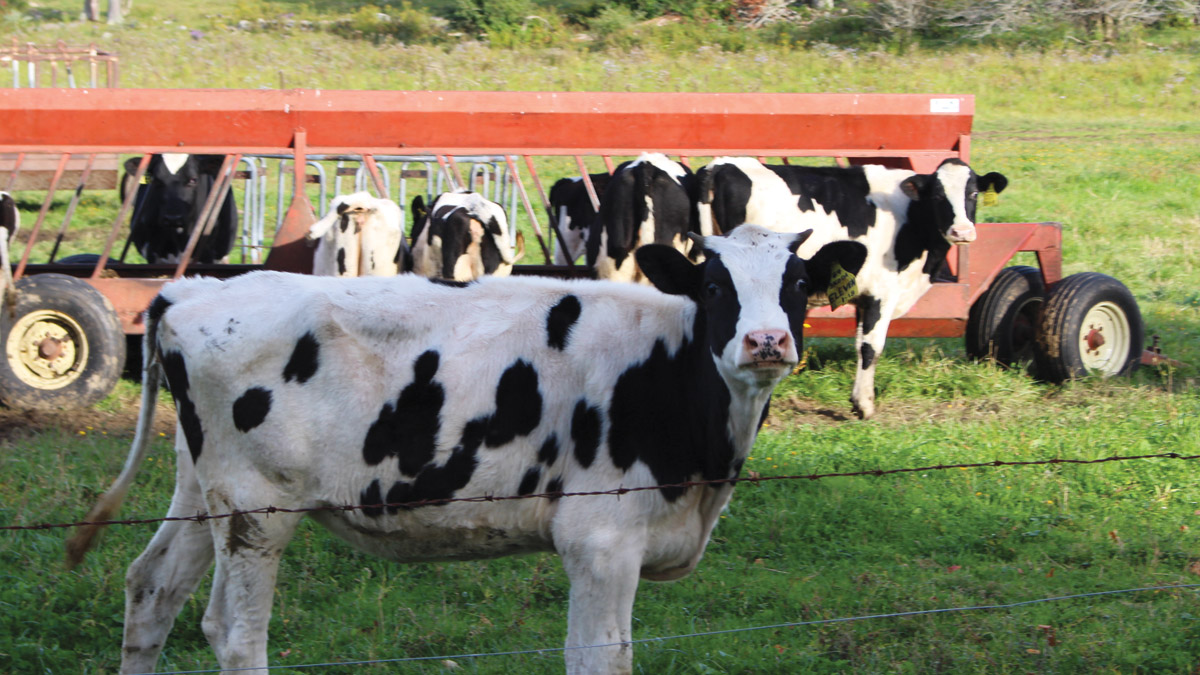
Huntley cows

Conservation leverages change

Now, thanks to a recent NYS Farmland Protection Diary Program grant, written by THTLT on behalf of the family, the Huntley’s are working to conserve their land.

The grant program recognizes the importance of dairy farms to NYS’s economy and rural communities and the need to increase the long-term viability of these farms. The Huntley’s are able to invest in improvements that will enhance their farming operation.

Dillon and Dan will use the funding to upgrade their milking facility, as well as implement additional farm improvements for cow comfort and soil management.

“These enhancements will make our small, family-run farm, more sustainable—and we know that the 200 years our family has invested here is now more secure. It’s a great feeling to create a strong economic future as part of preserving our farm’s heritage,” explains Dillon.

One of many farms…

In addition to the Huntley farm, THTLT is working with three additional farms awarded grants by the NYS Farmland Protection Dairy Program: the Northrup & Sons Farm in Rodman and Adams, Jefferson County; the Groeslon Farm in Remsen, Oneida County; and the Jones Farm in Trenton, Oneida County. This adds to several other THTLT farmland conservation projects currently underway.

“These families are leaders in their own right; they care deeply for the land and want to make sure their farms remain part of their community,” explains Linda Garrett, Tug Hill Tomorrow Land Trust’s Executive Director.

Jane Powers, Pierrepont Town Supervisor, notes that land trusts like Tug Hill Tomorrow are often pivotal in a farmer’s ability to apply for these grants, remarking, “It takes a lot of time to pull together the grant applications, let alone undertake the land protection work. We are delighted that the Tug Hill Tomorrow Land Trust jumped on this opportunity on behalf of our town’s dairy farms.”

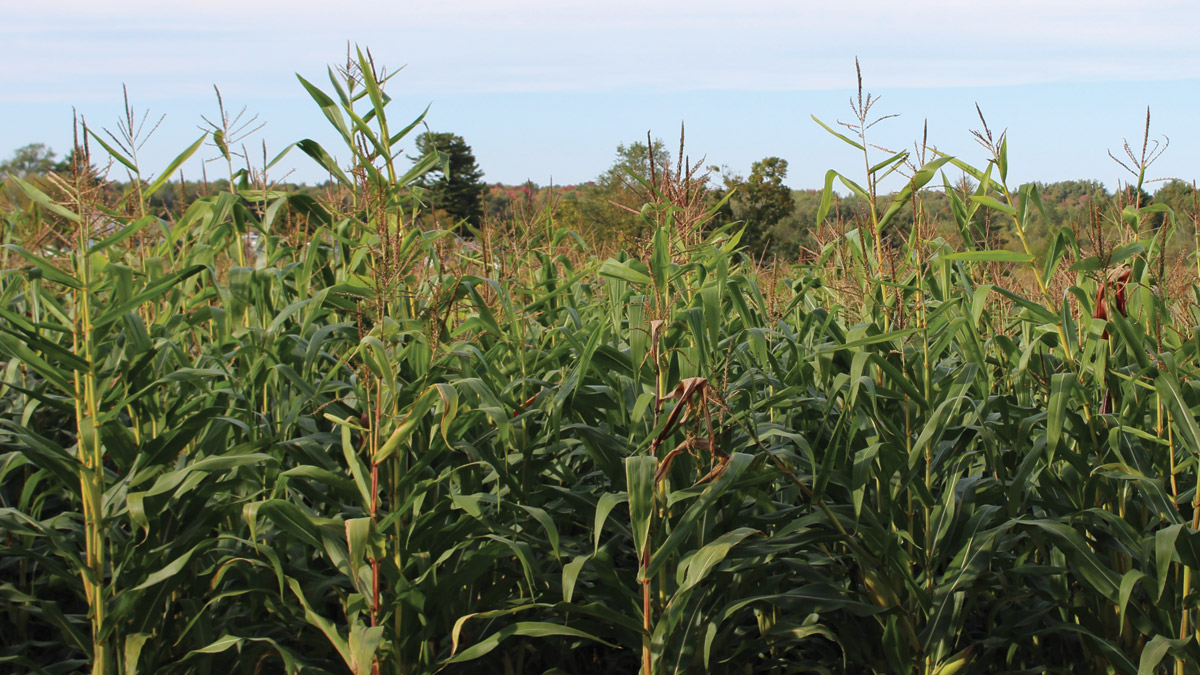
Huntley corn


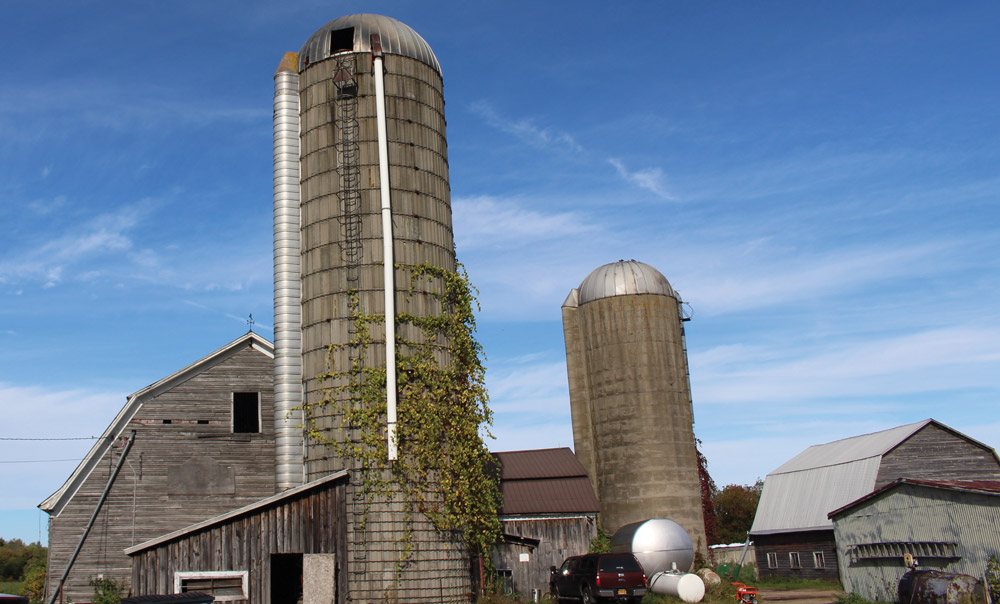
Huntley barns

We need you more than ever

In the coming year, your support will be central to our ability to work with additional farmers. It’s important to understand that as a community-based land trust, we can’t conserve these lands without you.

Farmland protection work is often a two- to three-year process, and your donations allow us to help farmers tap into the state farmland protection grants and protect their lands.

Without these grants, it’s often difficult to transfer the land to the next generation. Thanks to you, these farms will be here for generations.

Report Sheds Light on Role of Land Trusts in Climate Change

land trust in climate change brochure

The Land Trust Alliance sees land conservancies as key to implementing renewables.

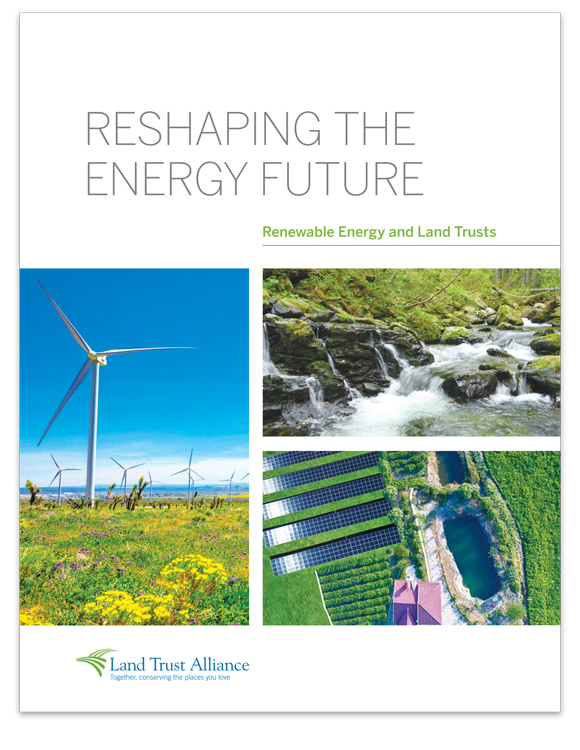
Reshaping the Energy FutureAt first blush, putting “open space” and “land conservancies” and “renewable energy” in the same sentence might seem awkward. But the role that land trusts play in addressing climate change via renewables can’t be understated, according to a new report from the Land Trust Alliance (LTA): “Reshaping the Future: Renewable Energy and Land Trusts.”

In the 24-page report, researchers said that at this “critical juncture, land trusts can position themselves as both protectors of priority lands, waters, and habitat and as problem-solvers in helping meet renewable energy development needs. As entities that care deeply about the land, land trusts should also care about climate change and renewable energy.”

That “critical juncture” is the impetus behind global efforts to reduce greenhouse gases by transitioning to renewable energy sources such as wind and solar.

The authors of the report described making investments in renewables as “critical to mitigating the worst impacts of climate change, such as flooding, loss of native species and habitat, and drought.” Land trusts can help with education and outreach as well as “siting” for renewable energy projects.

“Stakeholders, including land trusts, political leaders, developers, towns, local and state governments, public agencies, clean energy advocacy groups and nonprofits are exploring how to build a clean energy system, how to accelerate large-scale solar and wind development while also preserving the agricultural, ecological, recreational, scenic and other conservation resources that compose New York’s natural assets,” the LTA stated in the report.

The report summarized the role of land trusts and as well as the scope of New York’s “Progressive Energy Agenda.” Other topics included the relationship between land trusts, climate change and renewables, which noted that organizations can institutionalize “land conservation considerations” directly into the decision-making process and policy development. Land trusts can also prioritize efforts to minimized environment impacts on a project-by-project basis.

And lastly, land trusts can protect “priority ecological sites and other natural areas while also working with partners to identify places where development is appropriate, including where conservation and renewable energy development can coexist.”

The report also identified some challenges and opportunities for setting sights on addressing climate change via renewable energy. The LTA report noted the “dual role” of land trusts in conserving open space while also playing an active role in New York’s “energy agenda.”

“Land trusts are already addressing climate in a variety of ways — integrating climate resilience science into strategic planning, advancing natural climate solutions and developing carbon offset projects,” authors of the report said in conclusion. “Renewable energy presents another opportunity for land trusts to address climate change, to become valued community partners in helping to solve a complex issue and, ultimately, to safeguard our nation’s natural assets.”

Learn How To Save Your ASH

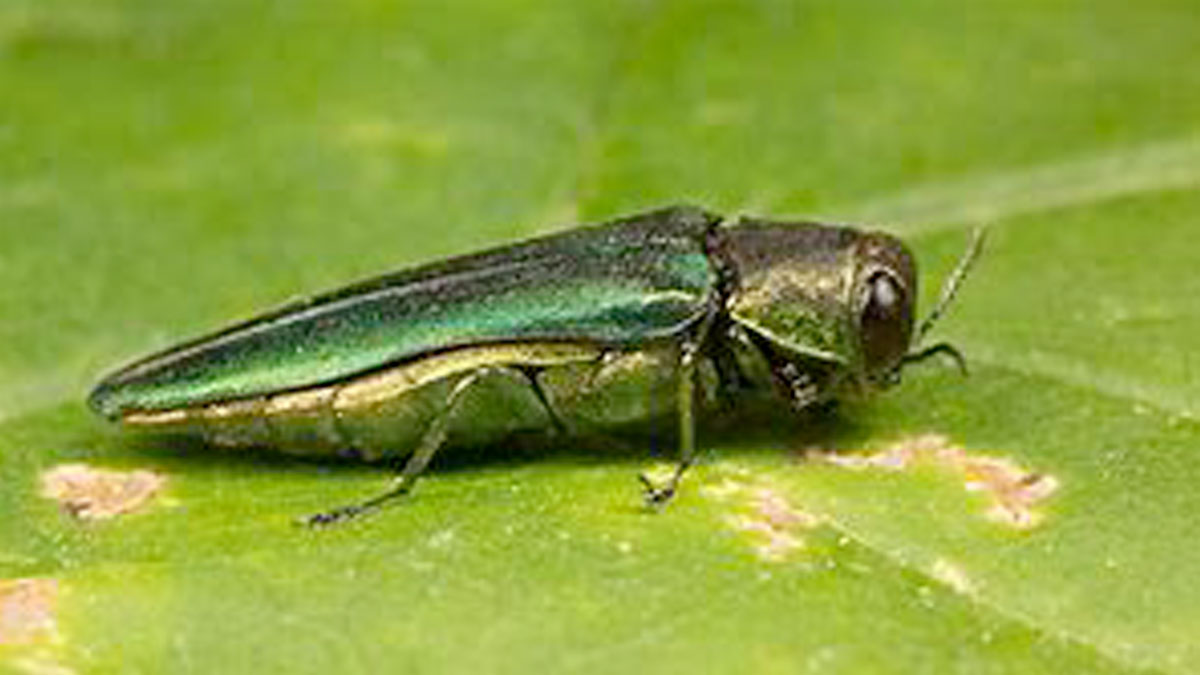
emerald ash borer

The MaMA program of the Ecological Research Institute (www.MonitoringAsh.org) provides constructive actions to take at each stage of Emerald Ash Borer (EAB) invasion, including even pre-invasion and the final invasion stage, when almost all of an area’s ash area have been killed by this invasive beetle.

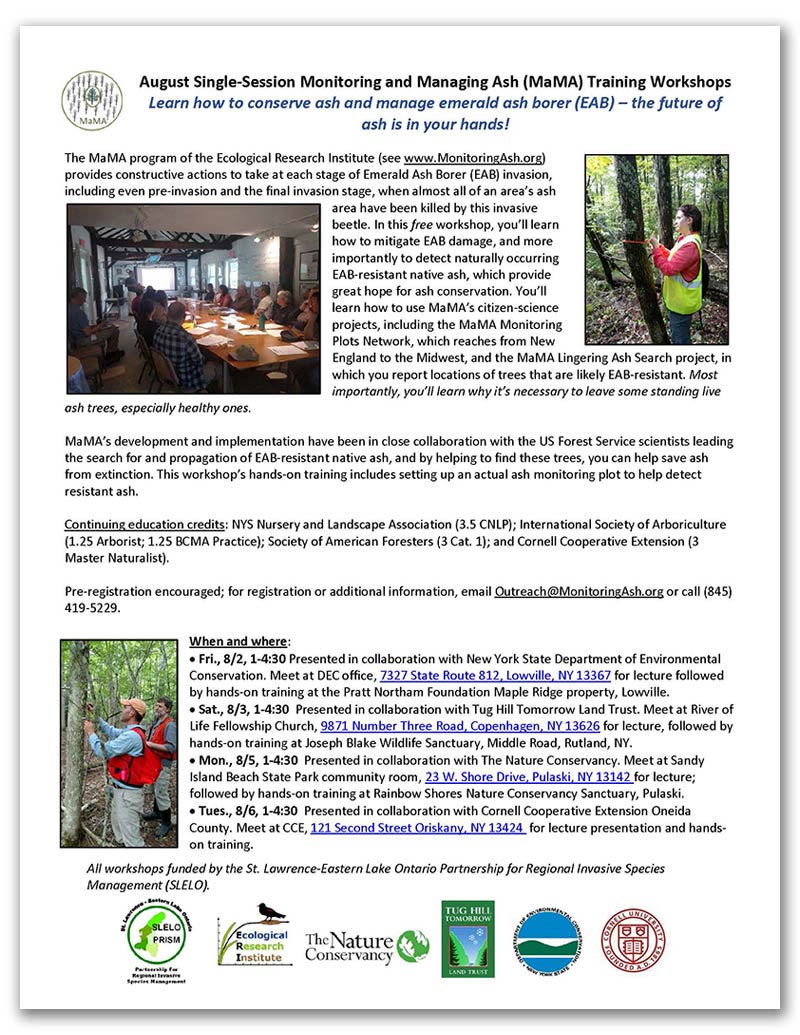
SLELO MaMA WorkshopIn this free workshop, you’ll learn how to mitigate EAB damage, and more importantly to detect naturally occurring EAB-resistant native ash, which provide great hope for ash conservation. You’ll have the opportunity to take-part in projects, including the MaMA Monitoring Plots Network, which reaches from New England to the Midwest, and the MaMA Lingering Ash Search project, in which you report locations of trees that are likely EAB-resistant. Most importantly, you’ll learn why it’s necessary to leave some standing live ash trees, especially healthy ones. 

Download Workshop Overview & Schedule

Choose one that works for your schedule:

Fri., 8/2, 1-4:30 Presented in collaboration with New York State Department of Environmental Conservation. Meet at DEC office, 7327 State Route 812, Lowville, NY 13367 for lecture followed by hands-on training at the Pratt Northam Foundation Maple Ridge property, Lowville.

Sat., 8/3, 1-4:30 Presented in collaboration with Tug Hill Tomorrow Land Trust. Meet at River of Life Fellowship Church, 9871 Number Three Road, Copenhagen, NY 13626 for lecture, followed by hands-on training at Joseph Blake Wildlife Sanctuary, Middle Road, Rutland, NY.

Mon., 8/5, 1-4:30 Presented in collaboration with The Nature Conservancy. Meet at Sandy Island Beach State Park community room, 23 W. Shore Drive, Pulaski, NY 13142 for lecture; followed by hands-on training at Rainbow Shores Nature Conservancy Sanctuary, Pulaski.

Tues., 8/6, 1-4:30 Presented in collaboration with Cornell Cooperative Extension Oneida County. Meet at CCE, 121 Second Street Oriskany, NY 13424 for lecture presentation and hands-on training.

Pre-registration is encouraged; for registration or additional information e-mail [email protected] or, call (845)419-5229.

When Farmland Matters

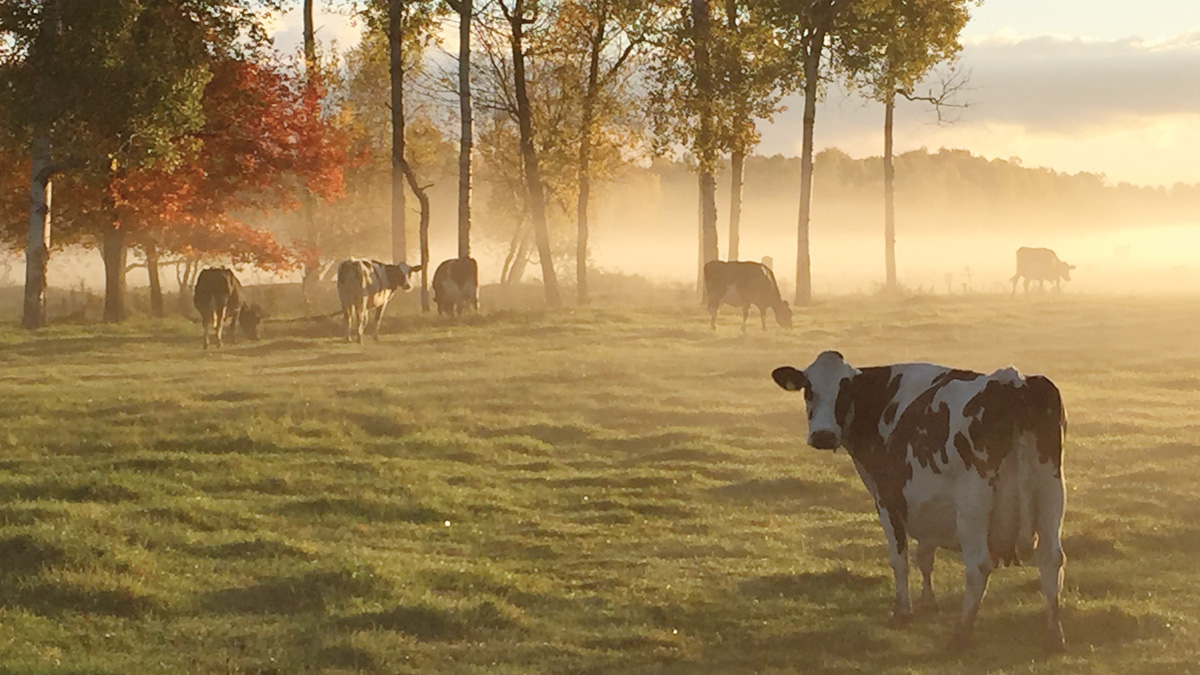
Cow Pasture in the Fog

“This land is part of our family, our community. It becomes part of who you are.” – Ed Siebels

Across the country, and here in New York State, farms face ongoing threats of development, tough market conditions, and aging farm ownership.

But there are some bright spots.

  • Ed Siebels, whose family has farmed their land for three generations, explains “farmland conservation is key to passing our land to the next generation—it makes it more affordable and keeps it out of developers’ hands.”
  • Find out how the Siebels family and others conserved their farms; farms and forests are important to the viability of Fort Drum and our national security; and wildlife are getting a boost from area landowners and partnerships.
  • Check out the ways nature, and the free programs offered by Tug Hill Tomorrow Land Trust, are changing kids for the better in schools, libraries, and out on the land.

THTLT Annual Report 2018To learn more, see beautiful pictures of conserved land, and read our most recent Highlights and Annual Report


All privately protected land stays on local tax rolls and continues to be managed by the people who own these properties.
Photograph courtesy of Jennifer Nightingale.

A Farm Rises from Ashes

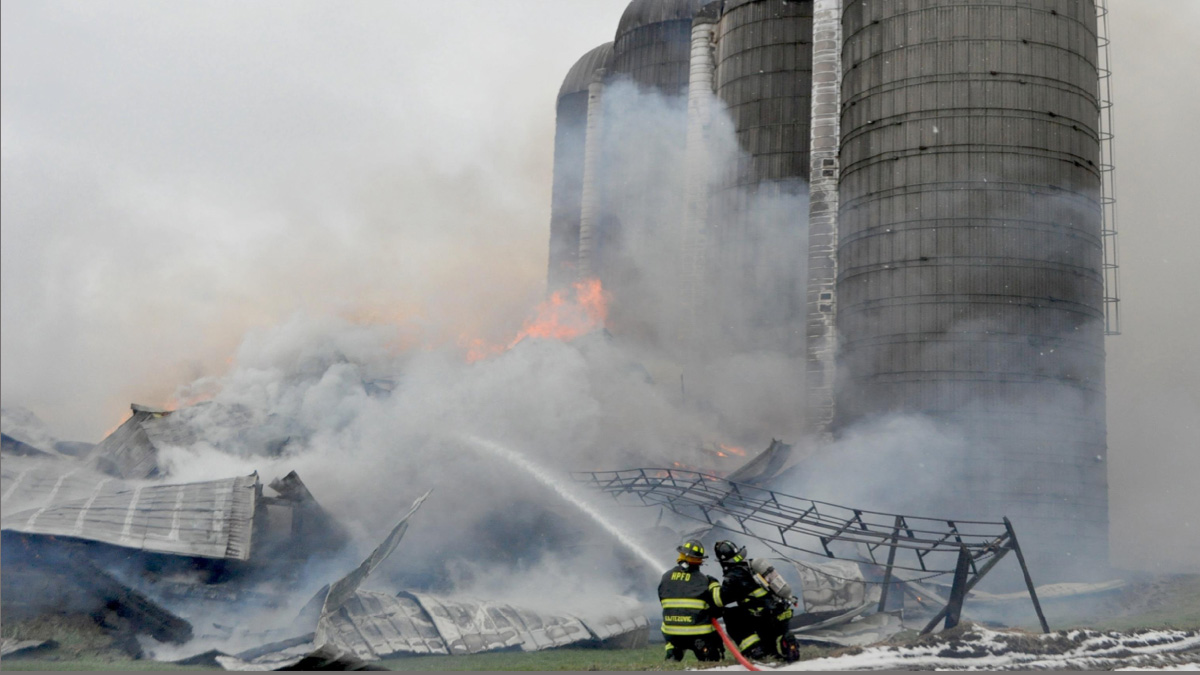
Jones Fire

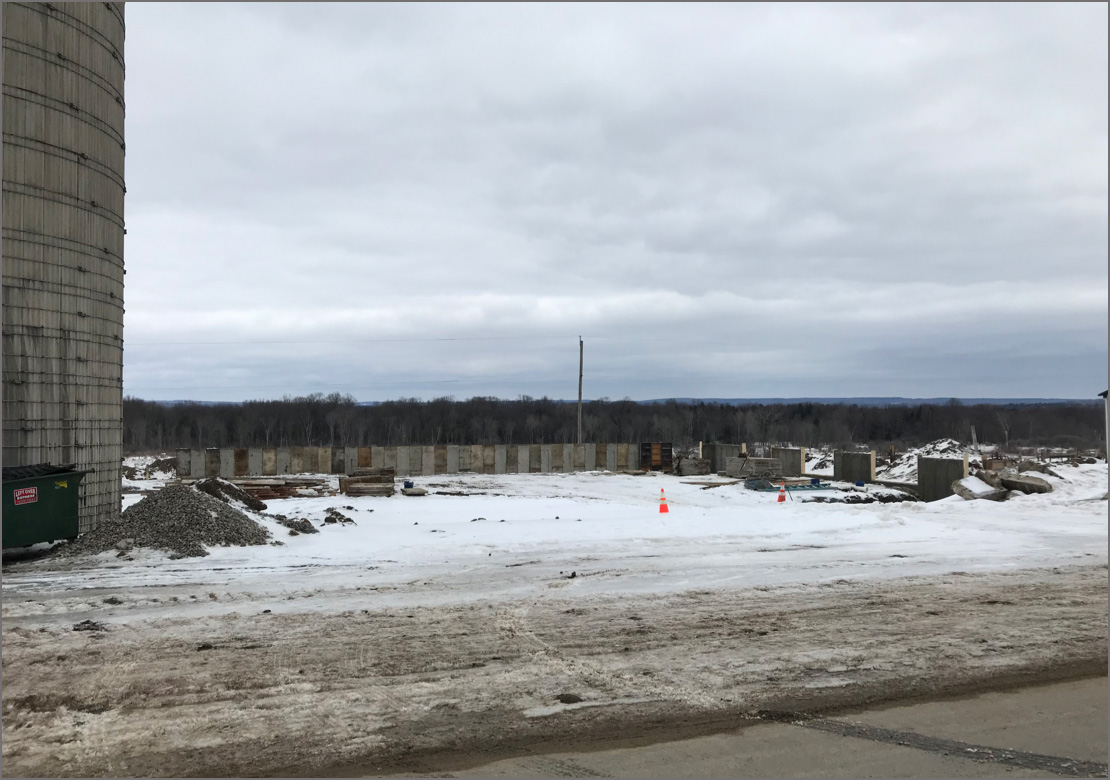
after the fireTerry Jones worked on his farm in Trenton for 50 years. It was passed down from his grandfather and is his home, his livelihood, his passion.

Tragically, Jones’ barn burned to ashes in a fire in early January, 2019. He lost all 200 of his dairy cows in addition to equipment and supplies. One day after this tragic accident, we received the news that a New York State Department of Agriculture and Markets grant that was applied for in the fall of 2018 to assist in purchasing a conservation easement on Jones’ 740-acre farm was approved.

With that news, Terry decided he will not be throwing in the towel. He will be re-building the barn, buying new cows, and will be able to plan for future generations.